Posts

Showing posts with the label 6th Arr.

Painting the Town Blue and Gold
Image
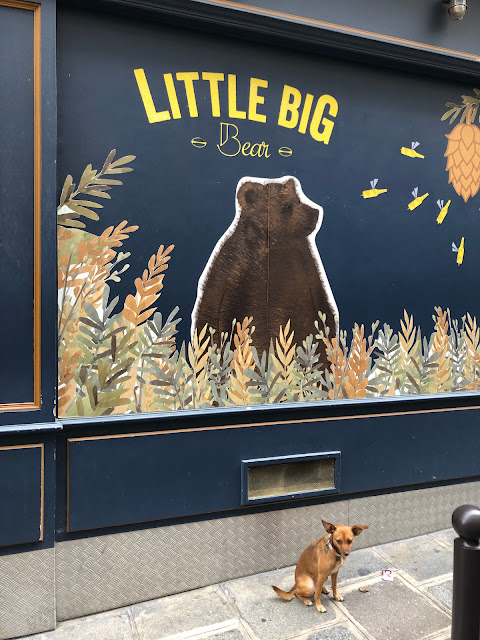
Little Big Bear, bedecked in glorious Blue and Gold, 6th Arr. For reasons I have not figured out, there seem to be more than a few allusions to Berkeley and its iconography around France. So far I have found two restaurants in Paris named "Berkeley;" another in Lyon was painted Blue and Gold, as is the Little Big Bear Pub in Paris' 6th Arrondissement. One wall of honor in Harry's New York Bar--operating in the 2nd Arr. since the 1920s--rightly places a vintage Oski pennant above hundreds of others.  Oski glowers from atop a wall in Harry's New York Bar, 2nd Arr. A trio of Berkeley establishments in Lyon, and in the 8th and 7th Arrs. The restaurant names probably refer to either Berkeley Square in London--which sits on land originally owned by the third Baron Berkeley of Stratton (1663-1697)--or to the Irish philosopher George Berkeley (1685-1753), Bishop of Cloyne. From what I can recall from my undergraduate philosophy courses (not much), Bishop Berkeley (pronoun...
All Hallows: Egyptomania

Image
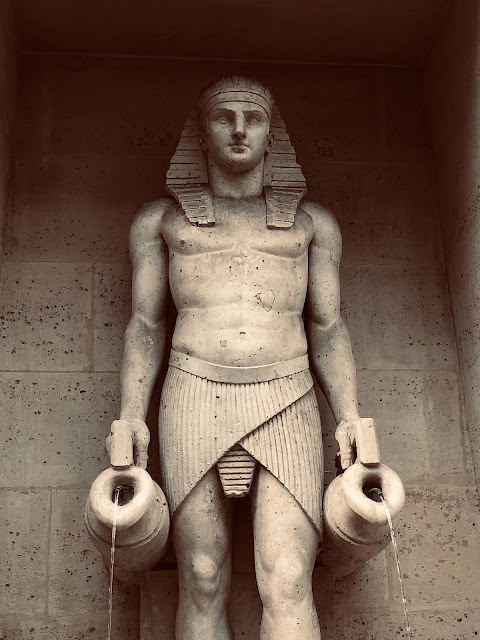
Fontaine du Fellah (1806), 7th Arr. Napoleon Bonaparte's conquest (and looting) of Egypt set off a flurry of interest in the arts and culture of ancient civilizations that thrived along the Nile. The design motifs that made it back to Europe were of course a pastiche, jamming together different epochs and dynasties of the region that now includes both Egypt and Sudan. The pastiche approach is understandable. By the time Alexander III of Macedon conquered the region around 330 BCE, there had been about 3,000 thousand years of pharaonic rule, very little of which would be interpretable to the West until after the discovery of the Rosetta Stone by French scholars in 1799. But Egyptian motifs show up in quite a few places in Paris, such as the Fontaine du Fellah (1806) near the Vaneau metro station. Despite the name (which connotes "peasant fountain") the fountain is based on statues of Osiris, Egypt's ruler of the dead. You can also find sphinxes around town, including a...

Pareidolia: Who's Watching Whom?

Image
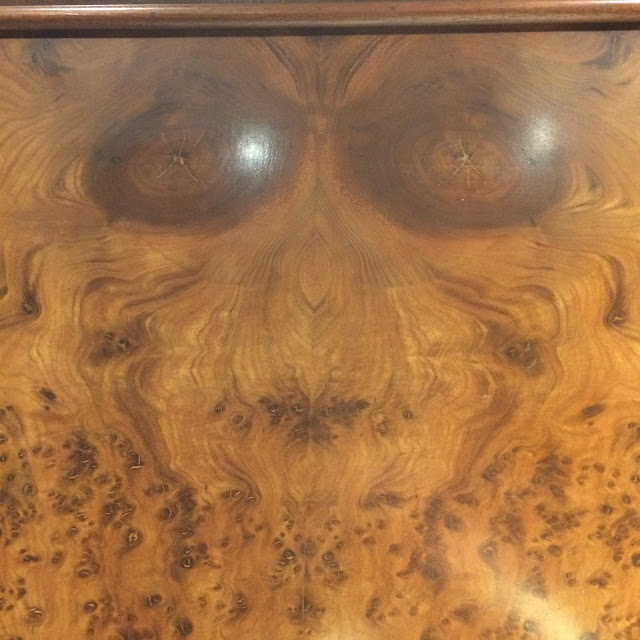
A witch in the burl, Claremont Hotel, Berkeley Pareidolia  is a phenomenon where your brain discerns meaningful patterns among random or ambiguous stimuli. It's why you recognize two parallel dots above an upward curving line as a smiley face--in fact, seeing human faces where none occur is the most common example of pareidolia. It's why a witch rides with you in one of the elevators at Berkeley's Claremont Hotel. And why some people insist that ancient civilizations built mountain-sized faces on Mars. I would argue that a lot of representative art depends on pareidolia to communicate meanings in forms in non-realistic ways. Though they are not realistic, we recognize animals and humans in cave paintings made 30,000 years ago at Lascaux and Chauvet because the artists intended to represent animals and humans. There is also the playful use of pareidolia in forms such as green men, where faces emerge from arrangements of plants. But often times, you just don't know if you...

Jazz Night in Paris

Image
Earlier this week we took in one of the shows at this year's Festival Jazz à Saint-Germain-de-Prés. Trumpeter Erik Truffaz's quintet was playing at the Odéon-Théâtre de l'Europe, a space for "les comédiens français" inaugurated by Marie Antoinette in 1782. Ceiling by André Masson (1965). The show was great, mostly an homage to film scores of classic noirs, the French new wave, and spaghetti westerns. For me, it really settled in about midway through when the program steered back to club jazz, including a duet for guitar and trumpet in the vein of Barney Kessel, and an accompaniment for two songs by a torch singer (whose name went past me in a blur of mumbled French). I could not bring myself to take photos during the show (etiquette, being present, etc.). From up in the balcony it was clear that many in the seats below were essentially recording the entire gig on their phones. I'm often struck by how much scorn is heaped on younger people for use and over-use ...

Mascarons of Paris: Planet of the Apes

Image
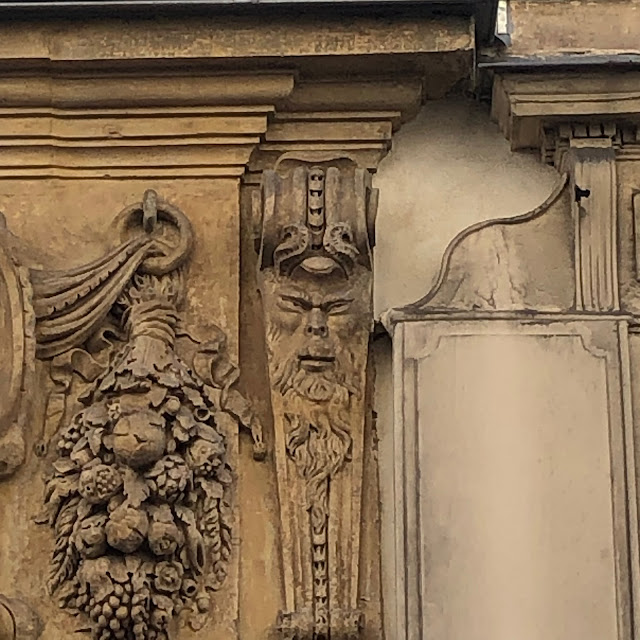
  Sixth Arrondissement, actually. But I could have sworn this mascaron was supposed to represent Dr. Zaius  from the 1968 movie. Which makes no sense until you recall that the film was based on French author Pierre Boule's 1963 novel La planète des singes . Which still makes no sense. But then again, monkeys are not unheard of in Paris. A far away planet or the distant future?

It Wants to be Spring Here

Image
  La Fontaine Saint-Sulpice, flowing in the 6th Arr. The fountains are flowing around town. Flowers are popping in the parks and the trees are starting to blossom. I saw four newly hatched ducklings at lÎle aux Cygnes today. Most of the mess from the garbage strike is gone. Lichen is not a sign of spring--but it makes a nice photo.   It wants to be spring here. But it ain't. This morning it was 1 degree celsius (34 F), and has gotten almost that cold overnight a few times in the last week. Just can't shake the need for wool coats, gloves, and scarves. People who transplant to the bay area usually love the mild weather, but seem compelled to say "but I miss the changing of the seasons." Having lived on the east coast of the U.S. and now in central Europe, I can tell you on good authority that seasons suck. People who like the changing seasons are experiencing cognitive dissonance: how else can they tolerate a place with five months of icy winter and four months of armp...

l'Horreur

Image
Greetings, kiddies, from the haunted flea market of Sainte-Ouen. To my great joy, I'm part of a generation that was raised on a heavy dose of spooky culture. On TV, old horror movies ran on weekends while reruns of the Munsters, the Addams Family, and Scooby Doo were on every day after school. Titles like "The Witching Hour," "Werewolf by Night," "Swamp Thing," and "Tomb of Dracula" were on the comic book racks at 7-11. "Monster Mash" and "Chilling, Thrilling Sounds of the Haunted House" got regular rotation on my record player. Basically, if you watched, read, or listened to anything targeted at kids back then, any normal day might include imagery of ancient cemeteries, old dark mansions, and crumbling castles. And that's not counting monster-themed toys and games (I know I built the Aurora glow-in-the-dark "Wolf Man" model, and maybe the "Mummy," too) or standard Halloween icons such as bats, witc...

Sugar Gets Around: Jardin du Luxembourg

Image
It wasn't long after we hit town in September that we started looking for neighborhoods with good spaces to walk dogs. Turns out, Paris parks are pretty dog-unfriendly. One exception is the Jardin du Luxembourg in the 6th Arrondissement. Marie de Medici, widow of Henri IV and mother of Louis XIII, added these gardens to her Palais du Luxembourg in 1612--part of which is now given over to dogs and their walkers (tourists and other Parisiens appear to be welcome as well). Le Palais du Luxembourg. Fit for a dog. Disturbingly, like at Ranelagh , the garden depicts yet another act of classical savagery. At la fontaine Médicis, a sculpture shows the giant cyclops Polyphemus moments before descending on lovers Acis and Galatea and crushing the former with a rock. Polyphemus, hanging junk and all, moments before his jealous rampage. Not fit for a dog. It's actually a grand and beautiful sculpture in bronze, stone, and marble. And if you bear any resentment against Polyphemus for destr...