Posts

Showing posts with the label horror

Side Trips: Vienna of Your Nightmares

Image
Kapuzinergruft , Vienna Vienna is the most beautiful, elegant, sophisticated place for contemplating what awaits beyond the veil of death and in the darkest corners of our nightmares. Amidst the baroque architecture, string quartets and bustling coffee houses serving schnitzels and tortes to tourists and locals alike, you will find more skulls, trolls, and demons per square kilometer than any other place I've ever been.   Anti-war and Anti-fascism monument, Vienna In some respects, this makes perfect sense. The Habsburg Empire, in its many iterations from roughly the 11th century until the end of WWI, encompassed huge swaths of Balkan, Carpathian, and Transylvanian eastern Europe. They likely absorbed the folklore of these lands, which was rife with fantastic beasts and horrific, undead revenants, as subjects and treasure were funneled back towards the seat of imperial rule in Austria. Still, that's not much of an explanation. Monstrous creatures are part of folklore around the...
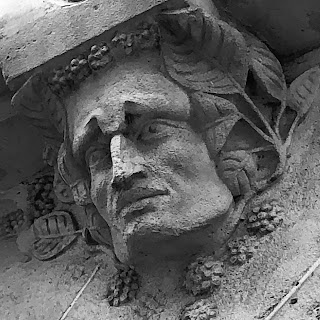
Mascarons of Paris: Frankenstein

Image
Left: Frankenstein mascaron, 7th. Arr. Right, Boris Karloff figure, Musée Grévin In the architecture and decorative arts around France, I've spotted resemblances to Dracula , the mummy , a sea creature , and more werewolves than I can recall. So it was just a matter of time before Frankenstein showed up. And yes, I refer to the creature as Frankenstein, against the tide of English literature professors and horror scolds alike. A key theme in Mary Shelley's 1818 novel is patrimony, specifically what fathers (in this case, the Creator) owe their progeny. If the Creature is Frankenstein's forsaken offspring (it is), early 19th century European society would have recognized its surname in fact, if not in legal entitlements. If everyone knew that a disavowed and neglected bastard was yours (and the readers of the novel certainly knew), and it had no given name and no known mother, by what other name could it be called but yours?  So the doctor is Frankenstein, and so, by custom...

Le Musée Grévin

Image
La Salle des Colonnes, Musée Grévin, 9th Arr. Le Musée Grévin is probably as close as Paris gets to a Pier 39 or Times Square-level cheesy tourist trap. Opened in 1882, it's a wax museum like any other you may have been to. There are some historical figures, current celebrities, and all-time favorite personages. I'm not well-versed on who's currently famous so I can't say whether the likenesses were spot on, but the figures were incredibly lifelike. Maybe it looked like Lady Gaga. Who knows? The dude in the jeep had a DeGaulle-like air about him, especially against a backdrop photo of the Arc de Triomphe. They also throw some curves at you, with figures placed and composed throughout the museum to look like other attendees. I stood for awhile watching a woman sitting on a bench near the entrance reading a museum guide. I was there just long enough that, had she moved, I would have been the creepy one. Grévin is good for what it is--and since it is a bit off-the-beaten p...

All Hallows: le Transi de René de Chalon

Image
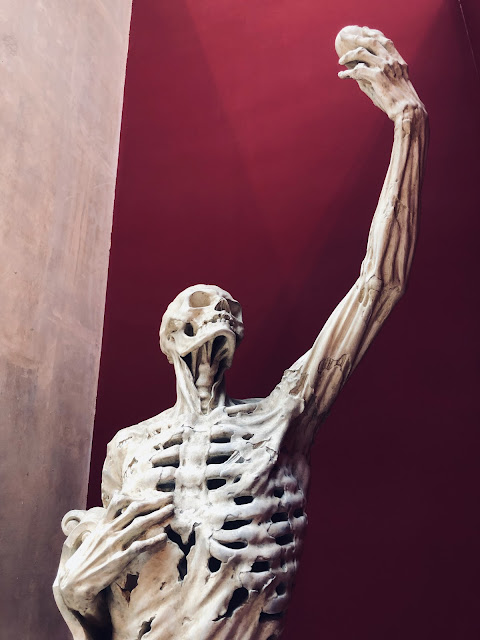
Reproduction of Ligier Richer's "Transi de René de Chalon" (1547), La Cité de l’Architecture et du Patrimoine, 16th Arr.  During the Renaissance period, transis --so-named because they showed the transition of mortal remains in the process of decomposition--became a fashion in burial art. One of the most evocative is the transi of René de Chalon, Prince of Orange, who was mortally wounded during the defense of Saint-Dizier (now part of the Haute-Marne department) in 1544, and who died soon after at age 25. Rather than opt for a heroic memorial, the Prince requested to be represented as a cadaver, in the same manner as his father and uncle who held the title before him. Originally, the cadaver's left hand held aloft the Prince's desiccated heart. At the time, burying nobles' body parts in separate places was a common practice, to better distribute the great person's glory. However, at some point, the heart went missing. The theft was blamed on that traditio...

All Hallows: Saint Denis Loses It

Image
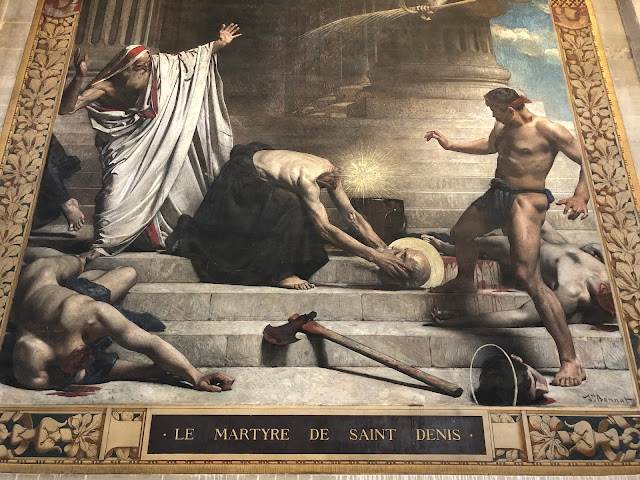
"Le Martyre de Saint Denis" by Léon Bonnat (1880), Pantheon, 5th Arr. Saint-Denis was the first Bishop of Lutece (now Paris), sent by Pope Fabian to convert the Gauls to Christianity in the 3rd century BCE. His efforts apparently annoyed some of the local pagan clergy, who complained to the Roman governor, who was already dealing with an ambiguous edict from Emperor Decisus regarding the status of non-ancestral Roman deities. Maybe it was all just a big misunderstanding, but it resulted in Denis and two companions getting dragged up to the highest hill in town and beheaded. That hill is now named Montmartre, a portmanteau for "martyr's mountain." What happened next must certainly have annoyed the original plaintiffs: Denis picked up his head, cradling it in his arms while preaching a sermon on his way back down the hill. The spot where he finished is now the site of Basilique Cathédrale de Saint-Denis . Saint-Denis, exterior of Cathédrale Notre-Dame, Reims Catho...

All Hallows: Hitchcock in Dinard

Image
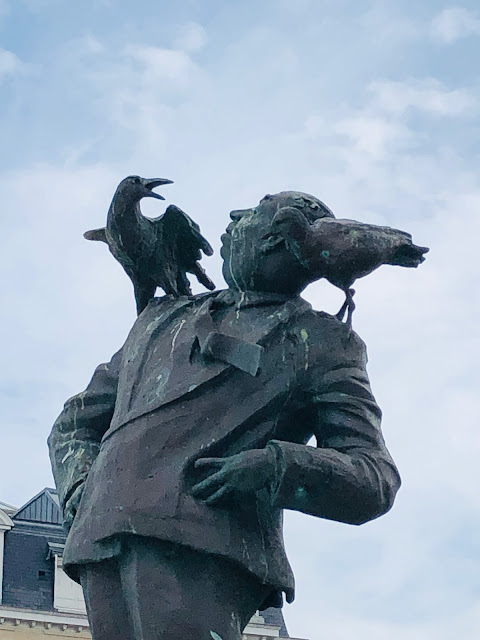
For over 30 years, the Dinard Festival du Film Britannique has awarded the Hitchcock D'Or (Golden Hitchcock) to the British film that best ... the best film that Britishes the best ... I have no idea. But then again I don't know how other prizes in the arts are awarded, either. But I do know that the seaside town of Dinard in Bretagne had the good taste to erect a statue of Alfred Hitchcock, paying homage to one of his two authentic horror films, The Birds  (1963). The master of suspense has a crow on one shoulder and a gull on the other--and is coated liberally in bird shit. If this trailer for the film is any indication, Hitchcock would have appreciated this subtle touch immensely. The movie is set in and around San Francisco and Bodega Bay, but the screenplay was based on a 1952 short story set in Cornwall, England by British author Daphne du Maurier--whose name at least sounds French, so maybe that is the Dinard connection. As if to salvage the French connection to horror...

All Hallows: Dinan

Image
A deserted medieval town in Bretagne. Strange, grinning creatures cling to the walls of the ancient basilica. Their staring eyes make feel that you are not really alone. In the window of an old curiosity shop, Le Druide de Folle Pensée , a small semi-circle of light from a single lamp is all that drives back the shadows. A parchment in a strange foreign tongue describes a creature that must exist only in nightmares and fever dreams. A set of pistols promises protection against "lycanthropes, vampires, et autres chimères." But it is the sachet of "potion de mutisme" that speaks most loudly in the silent village. The curiosity shop seems like the only going business around, and even it sits darkened and empty. We are nearly at the gates that will lead us beyond the walls of the city and we have yet to see a soul. Maybe whatever follows us will stay on this side. Maybe we all will.

All Hallows: Robertson's Phantasmagoria

Image
  A phantasmagoric bas-relief from Robertson's tomb, Cimitière du Père Lachaise, 20th Arr. I took the opportunity to create another entry for Atlas Obscura. This one was for the tomb of 18th century scientist and pioneer of spooky stage entertainments, Étienne-Gaspard Robertson . AO wrote a great story about Robertson years ago, but did not include particulars about visiting the tomb. It's a small thing, but I wanted to rectify it. Now I have. I won't rehash everything that you can read on AO, except to say that his grave in Cimitère du Père Lachaise is a marvelous homage to the kinds of nightmares he inflicted on audiences in the darkened crypt of the Convent of the Capucines. Not your usual cherubic decor. An engraving from Robertson's memoirs. Courtesy of Wikimedia Commons. As it happens, one of Robertson's other claims to fame was "aerostats," i.e., he would ascend in a hydrogen-filled balloon to take detailed measurements of meteorological and atmos...

All Hallows: Art Institute of Chicago and the Problem of Evil

Image
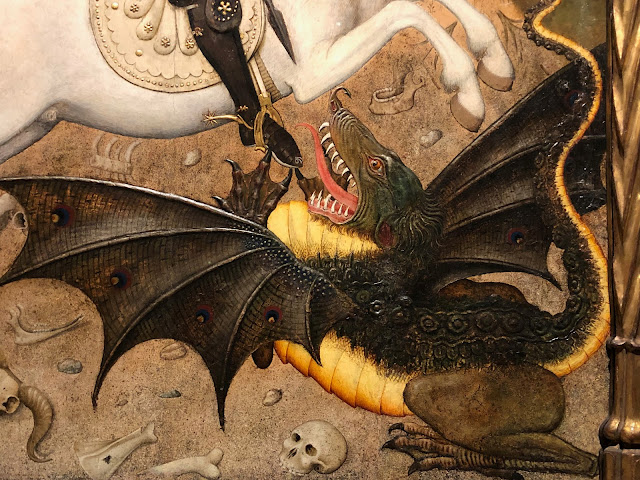
  Detail from Saint George and the Dragon, Bernat Martorell (1435) The Art Institute of Chicago may be best known for its curations of architectural details, its arms and armaments, and, of course, the magnificent  Un dimanche après-midi à l'île de la Grande Jatte by George Seurat. You are not ready for the pointillist masterpiece until you're standing in front of it, close enough to inspect each colored point. Then backstep briskly and try to get all 7' x 10' of it in one view, then scan from side to side to take in the elegant ladies, reposing flaneurs and scampering children as they enjoy a quiet Sunday with each other, their dogs and at least one monkey. Seurat's was probably the first impressionist work I ever learned about, entirely due to the short Charley and Humphrey puppet segments that used to run between cartoons in the 1970s on KTVU channel 2: "Seurat knew a lot about the dot. And now so do you!" But the AIC curates its share of creepers, as ...