Posts

Showing posts with the label 16th Arr.

All Hallows: le Transi de René de Chalon
Image
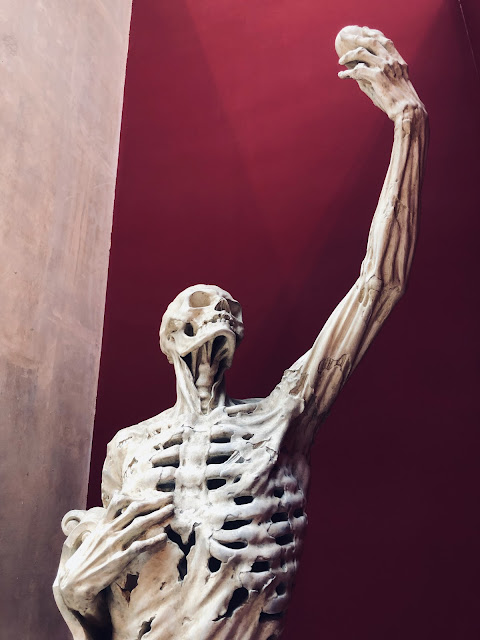
Reproduction of Ligier Richer's "Transi de René de Chalon" (1547), La Cité de l’Architecture et du Patrimoine, 16th Arr.  During the Renaissance period, transis --so-named because they showed the transition of mortal remains in the process of decomposition--became a fashion in burial art. One of the most evocative is the transi of René de Chalon, Prince of Orange, who was mortally wounded during the defense of Saint-Dizier (now part of the Haute-Marne department) in 1544, and who died soon after at age 25. Rather than opt for a heroic memorial, the Prince requested to be represented as a cadaver, in the same manner as his father and uncle who held the title before him. Originally, the cadaver's left hand held aloft the Prince's desiccated heart. At the time, burying nobles' body parts in separate places was a common practice, to better distribute the great person's glory. However, at some point, the heart went missing. The theft was blamed on that traditio...
Reptiles of the 7th Arrondissement (mostly)

Image
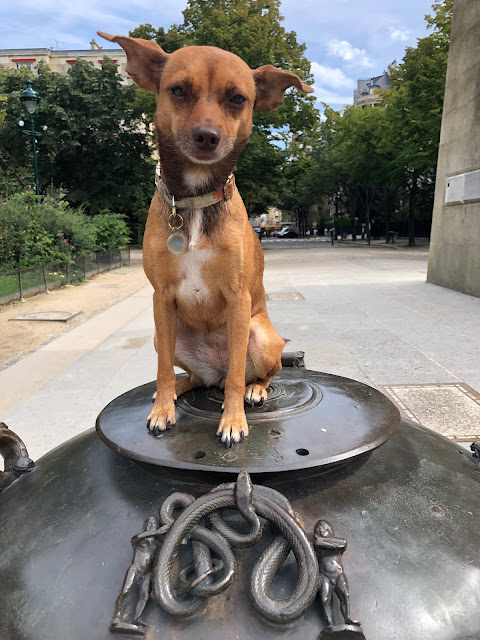
Garter snake on the Monument des Droits de l’Homme, Champ-de-Mars, 7th Arr. Snakes and lizards--and at least one two-headed turtle--are a recurring motif around Paris. In some cases, they are baffling symbols, such as the garter snakes that adorn the Monument des Droits de l’Homme ("rights of man"), above. Then again the entire Monument, installed at the Champ-de-Mars in 1989 for the 200th anniversary of the Revolution, is a confusing mix of Masonic and Masonic-adjacent symbols--including the ouroboros snake eating its own tail, an occult classic. So random obfuscation may be part of the monument's theme, which may or may not be a commentary on the rights of man. The ouroboros of the Monument des Droits de l’Homme. Reptile symbolism is a bit clearer when used in classical motifs. For example, snakes routinely appear on medical symbols such as the caduceus and the rod of Asclepius (the Greek god of medicine). The façade of the 1808 Fontaine de Mars (La Fontaine du Gros-Cai...

More Food

Image
Though I would never consider myself a gourmand, I'm by no means a fussy eater. But traveling in Europe and living in France reminds me that the typical American palate is actually pretty narrow--particularly where animal protein is concerned. Basically, Americans eat mostly cows, chickens, pigs, sheep and some fish and seafood. And with few exceptions such as tripe, caviar, and chopped liver, they mostly eat the muscles rather than the internal organs. These exceptions are important. How else would we know the boundaries if no one ever crossed them? But in the US, crossing those boundaries means doing some work to seek out the delicacies in specialty stores, rather than expecting to find them on any given menu or front-and-center in a typical chain supermarket. A whole store for snails. The difference in France's cuisine is in both the breadth of common ingredients and their ready availability. Snails, rabbit and blood sausage ( boudin noir ) can be had in the US, but they rar...

16 Hours of Daylight

Image
In Paris, I'm sitting at latitude 48 degrees, 50 minutes and 57 seconds north. For comparison, the only "major" cities in the U.S. that far north are Seattle, WA and Fargo, ND. Today (June 24), the sun rose at 5:48 AM and will set at 9:58 PM. That makes 16 hours and 10 minutes of daylight--or more than 17 hours of light using the conventions of "first light" and "last light." May 16, 10:16 PM Having always lived in more southernly latitudes (from 40 degrees N in New York to 34 degrees N in Los Angeles), these long early-summer days are bizarre. There are lots of people out on the streets--but that's usually true everywhere in Paris, all the time. Streetlights don't really come on until very late, and you get a good view of the bats working the trees late into the night. The warmest part of the very warm days (30 celsius today, 85 Fahrenheit) comes at about 5 or 6 PM, so it's not as if the evenings offer much relief in terms of temperature. ...

The Piper at the Gates of Dawn

Image
The Great God Pan in the 7th Arr. A few years back, I read Kenneth Grahame's The Wind in the Willows (1908) for the first time. I was not surprised that the book was very different than the story told in the 1949 Disney cartoon The Adventures of Ichabod and Mr. Toad , which was then my only point of reference. But I was not prepared for chapter 7 , in which Rat and Mole, after searching all night for Otter's lost child, have an eerie encounter with the great god Pan. “Rat!” he found breath to whisper, shaking. “Are you afraid?” “Afraid?” murmured the Rat, his eyes shining with unutterable love. “Afraid! Of Him? O, never, never! And yet—and yet—O, Mole, I am afraid!” Then the two animals, crouching to the earth, bowed their heads and did worship.  It seems like an odd passage in a children's novel, and Pan doesn't reappear anywhere else in the book. Then again, it may be the key to the entire story, especially if the cover of the book's first edition is any indicati...

Street Art: 16th Arr.

Image
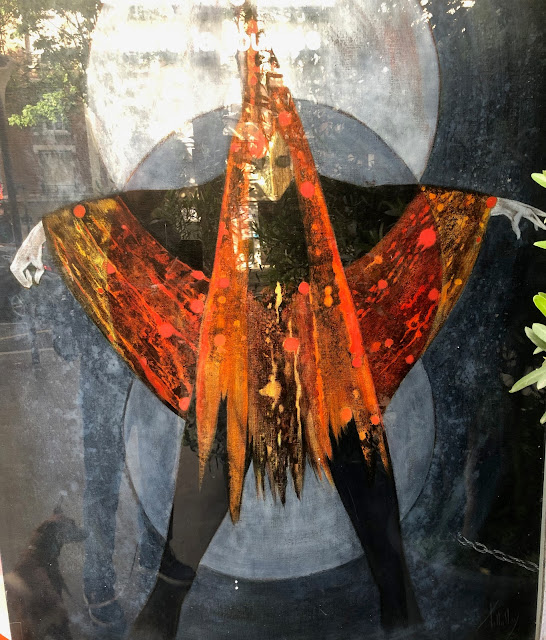
An ominous detail in the neighborhood. More ominous still, it's in the window of a dry cleaner. To paraphrase my esteemed colleague, Monsieur d'Hardan: "maybe they exorcise demons from your pants." Or maybe my French is even worse then I thought. l'Église d'Enfer means "dry cleaning," right? And why is the place guarded by a hellhound?

May Day

Image
Lily-of-the-valley ( muguet in France) is France's traditional May Day flower ( la fête du travail , or labor day over here). It has a very light scent used in perfumes and is highly poisonous--the flower, that is, not the holiday.  Muguet is traditionally sold tax-free on May Day, principally by labor organizations but also by anyone who sets up a table or booth on any street. Muguet et sucre. It's also traditional in France to hold May Day protests and demonstrations. This year's actions promised to resume expressing the nation's vast dissatisfaction with the recent change in retirement age from 62 to 64. As of 5 pm local time, there have been reports in Paris of dozens of arrests and at least one seriously injured police officer. Water cannons and tear gas were used to disperse protesters at Place de la Nation in the 11th Arrondissement. In Marseille, the lobby of the InterContinental Hotel was briefly "occupied" by about 200 protesters. The CGT, one of t...

Mascarons of Paris: From the Colonies to the 16th Arr.

Image
A pair of curious mascarons from different buildings in the 16th Arr. I suspect they represent some of France's former colonies. On the left, from a 1925 building, could be Indochina, which gained final independence from France in the 1950s. On the right could be Guyane (aka French Guiana), which was a colony but became a department of France in the 1940s after WWII (in France, a department is an administrative area like a county or state in the U.S.). While these are the first I've noticed on mascarons, artistic representations of indigenous peoples would not have been uncommon during France's long colonial period. For example, the statues outside of the Musée d'Orsay feature women from the six continents in traditional attire (although probably mythical or imagined--Europe's lady looks more like a Valkyrie than anything else), commissioned for the 1878 l'Exposition Universelle . More to the point, the Jardin d'Acclimatation in the Bois de Boulogne featured...

The Naked and the Nude

Image
If your apartment overlooks Place Rodin in the 16th Arr. and you love art, you might feel lucky to see a cast of Auguste Rodin's "l'Âge d'Airain" (The Bronze Age) every time you look out your window. There are casts of it in the Musée d'Orsay, the Victoria and Albert Museum in London, and the Met in New York. So I feel like I'm getting a good deal when I walk by it for free a few times a week on my way to Jardin de Ranelagh.  If you don't like art, it's just a guy flashing you--which may or may not be an issue. He's been there since 1947, so there would be little point in complaining if you didn't want to see it. Two perspectives of Rodin's "l'Âge d'Airain." Not that many people in France would bother complaining. Nudity in public art in the U.S. isn't very common, and is almost unheard of as exterior decoration on buildings. That's what made Attorney General John Ashcroft's cover-up of the "Spirit of ...

A Dream is a Wish Your Heart Makes

Image
We awoke at 6:30 this morning to the most beautiful sound known or imaginable to humankind: a garbage truck. "Patience," indeed. After almost two weeks without pickup left half the city with chest-high piles of garbage and trash blowing through the streets, seeing cleanup crews was like Christmas morning, your birthday, and the last day of the school year rolled into one. It will take a long time before the crews get the city back to any semblance of "normally" dirty--i.e., clean enough so you don't notice the trash and can focus instead on not stepping in dog shit. And so far, it's not clear that they have made any progress in the 16th Arr. beyond our one tiny street. But at this point, I'll take what I can get.

Crossing the River in Style: Pont Mirabeau

Image
A monument to the pole-dancing Parisiennes of yore? Mais non ! Even better, a statue representing "Commerce" on the base of the Pont Mirabeau. Can't it be both? The Pont Mirabeau bridge stretches across the Seine, connecting the 16th and 15th Arrondissements. It was completed in 1896, and features four allegorical statues sailing the Seine on its two piles. Whatever else they are supposed to represent, these figures wield some fierce weaponry (with the exception of "Navigation," whose hands are full with the practical task of steering the ship). "Commerce" "La Ville de Paris" "Abundance" "Navigation" In addition to being highly useful, the bridge adds a bit of glamour to what is essentially a reclaimed industrial area. On the banks of the 15th Arr. is a Cemex cement factory and a park where the Citroën factory once stood. On our side is the Voie Georges Pompidou expressway. Views of Pont Mirabeau from Quai Louis Bleriot, a...