Posts

All Hallows: le Transi de René de Chalon
Image
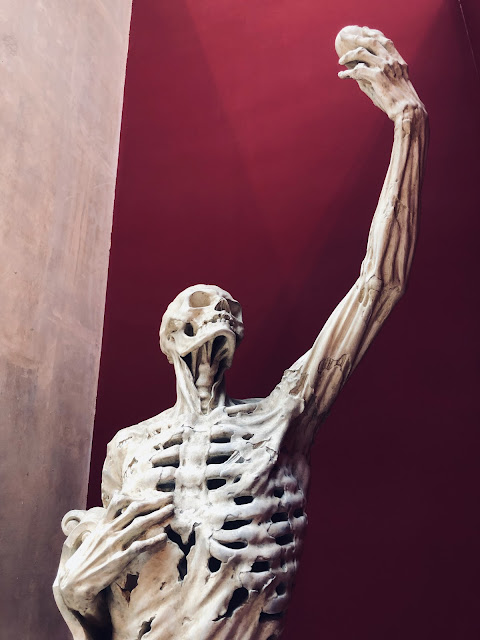
Reproduction of Ligier Richer's "Transi de René de Chalon" (1547), La Cité de l’Architecture et du Patrimoine, 16th Arr.  During the Renaissance period, transis --so-named because they showed the transition of mortal remains in the process of decomposition--became a fashion in burial art. One of the most evocative is the transi of René de Chalon, Prince of Orange, who was mortally wounded during the defense of Saint-Dizier (now part of the Haute-Marne department) in 1544, and who died soon after at age 25. Rather than opt for a heroic memorial, the Prince requested to be represented as a cadaver, in the same manner as his father and uncle who held the title before him. Originally, the cadaver's left hand held aloft the Prince's desiccated heart. At the time, burying nobles' body parts in separate places was a common practice, to better distribute the great person's glory. However, at some point, the heart went missing. The theft was blamed on that traditio...
All Hallows: Saint Denis Loses It

Image
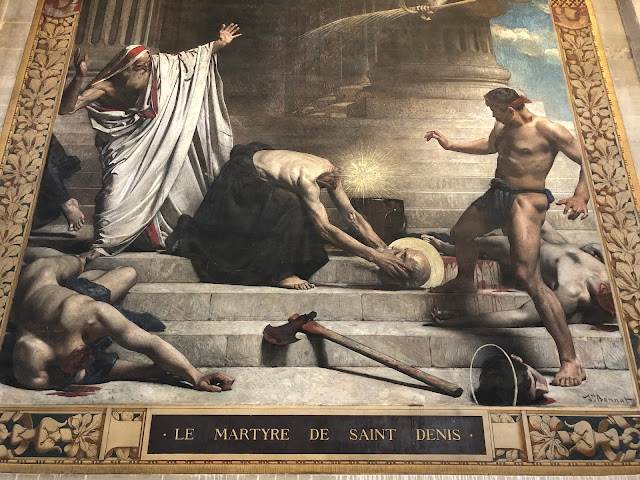
"Le Martyre de Saint Denis" by Léon Bonnat (1880), Pantheon, 5th Arr. Saint-Denis was the first Bishop of Lutece (now Paris), sent by Pope Fabian to convert the Gauls to Christianity in the 3rd century BCE. His efforts apparently annoyed some of the local pagan clergy, who complained to the Roman governor, who was already dealing with an ambiguous edict from Emperor Decisus regarding the status of non-ancestral Roman deities. Maybe it was all just a big misunderstanding, but it resulted in Denis and two companions getting dragged up to the highest hill in town and beheaded. That hill is now named Montmartre, a portmanteau for "martyr's mountain." What happened next must certainly have annoyed the original plaintiffs: Denis picked up his head, cradling it in his arms while preaching a sermon on his way back down the hill. The spot where he finished is now the site of Basilique Cathédrale de Saint-Denis . Saint-Denis, exterior of Cathédrale Notre-Dame, Reims Catho...

All Hallows: Little Devils

Image
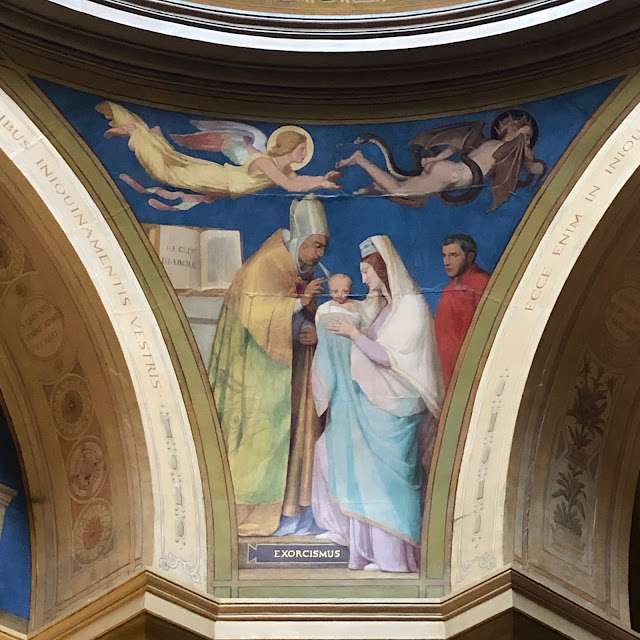
The baptism chapel of Église Notre-Dame-de-Lorette, 9th Arr. If you've attended (or participated in) a baptism that welcomes a baby into the Catholic church, you will have noticed that the priest's language explicitly rebukes Satan, asks the child's parents and godparents to do the same, and offers prayers that the child can be freed from original sin. This is in fact a ritual of exorcism. But don't expect the spookshow popularized by William Peter Blatty's 1971 novel The Exorcist , and reinforced by countless derivative (mostly bad) films, books, TV shows, and sham documentaries. No levitating babies with spinning heads or speaking backwards in ancient Aramaic--just a mass celebrated with family and their friends. If you do experience otherwise, I don't need to advise you to contact a young priest and an old priest. You've seen the movies. You know the routine. Even knowing that baptism is a lower-case exorcism, the upper-case Exorcist book and movie casts...

All Hallows: Ghost Rider

Image
"Cavalier fantôme," Coulée Verte René-Dumont, 12th Arr. Along the Coulée Verte René-Dumont in Paris' 12th Arr., the concrete dividers separating the bike and pedestrian lanes have been given over to street art. The coulée's gardens and path run along the lines of a decommissioned freight railroad. It's not clear if the barriers are part of the city's public art plan for the park, or if they were simply an irresistible canvas for local artists. Some works seem commissioned, others seem renegade. You be the judge. "Faire pipi," Coulée Verte René-Dumont "Les robots sont partout," Coulée Verte René-Dumont Any road barrier in France is a potential masterpiece. Bordeaux.

All Hallows: Saint-Malo

Image
La Crêperie des Lutins, Saint-Malo, Bretagne Maybe it's Bretagne's Celtic heritage, but La Crêperie des Lutins ("the elves' creperie") seemed to have a strong American Halloween motif going. There's the pumpkin sign hanging above the door, with an elf dressed as a pirate. We know that it's a pirate costume because, of course, Saint-Malo had no pirates, just corsairs . Inside the restaurant was a mural of fairies, elves and other forest spirits, and small figurines of pointy-hatted witches were sprinkled throughout the place. In spite of all this kitsch, it was a good place to eat, with bowls of locally made cider and crispy galettes (savory crêpes stuffed with ingredients such as cheese, ham, onions and mushrooms; basically omelettes wrapped in wafer-thin buckwheat pancakes instead of eggs). This was pretty much the menu of 90% of the restaurants inside the walls of Intra-Muros, Saint-Malo's old town. But visitors to Bretagne expect crêpes, cider, oyst...

All Hallows: Hitchcock in Dinard

Image
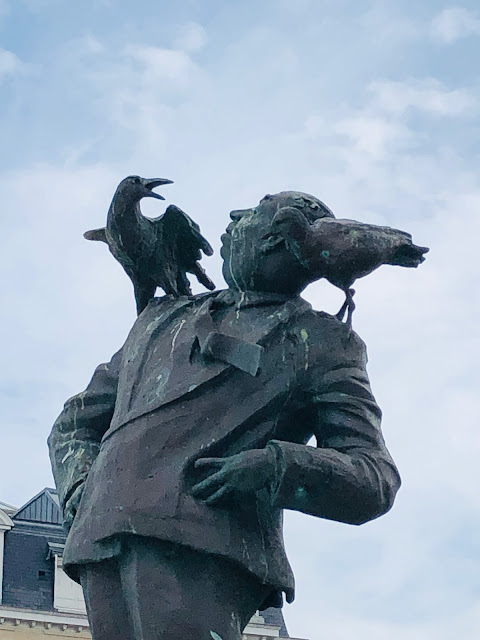
For over 30 years, the Dinard Festival du Film Britannique has awarded the Hitchcock D'Or (Golden Hitchcock) to the British film that best ... the best film that Britishes the best ... I have no idea. But then again I don't know how other prizes in the arts are awarded, either. But I do know that the seaside town of Dinard in Bretagne had the good taste to erect a statue of Alfred Hitchcock, paying homage to one of his two authentic horror films, The Birds  (1963). The master of suspense has a crow on one shoulder and a gull on the other--and is coated liberally in bird shit. If this trailer for the film is any indication, Hitchcock would have appreciated this subtle touch immensely. The movie is set in and around San Francisco and Bodega Bay, but the screenplay was based on a 1952 short story set in Cornwall, England by British author Daphne du Maurier--whose name at least sounds French, so maybe that is the Dinard connection. As if to salvage the French connection to horror...

All Hallows: Dinan

Image
A deserted medieval town in Bretagne. Strange, grinning creatures cling to the walls of the ancient basilica. Their staring eyes make feel that you are not really alone. In the window of an old curiosity shop, Le Druide de Folle Pensée , a small semi-circle of light from a single lamp is all that drives back the shadows. A parchment in a strange foreign tongue describes a creature that must exist only in nightmares and fever dreams. A set of pistols promises protection against "lycanthropes, vampires, et autres chimères." But it is the sachet of "potion de mutisme" that speaks most loudly in the silent village. The curiosity shop seems like the only going business around, and even it sits darkened and empty. We are nearly at the gates that will lead us beyond the walls of the city and we have yet to see a soul. Maybe whatever follows us will stay on this side. Maybe we all will.